What Actually Stops Retail Theft in an Orange County Store
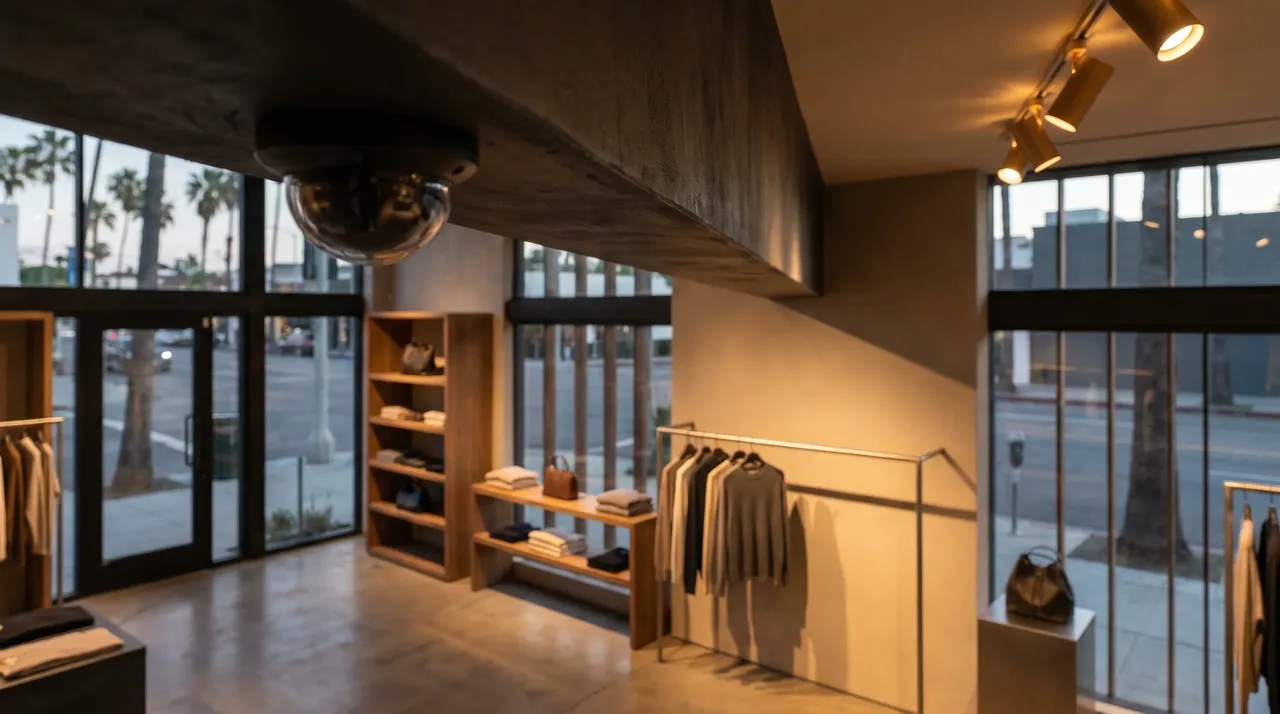
Most of the retail security spending we see in Orange County is theater. Not because OC is a high-crime place — it isn't — but because owners buy hardware to feel covered, then never build the part that would actually change an outcome. The most common version of this is a store with eight cameras, all doing the same thing: recording footage that would prove a loss happened without giving anyone a single tool to prevent the next one.
That gap is the whole story of retail loss. Owners think they have a security system. What they actually have is an evidence-collection system nobody ever wants to use, because by the time you're reviewing footage, whatever walked out is long gone. South OC retail isn't fighting a crime wave — most days are quiet — but quiet doesn't mean zero, and the stores that handle the rare bad day well are the ones that thought about it before it happened.
Theft happens at predictable points, not random ones
Walk any store with a loss-prevention eye and you'll see the same vulnerable zones every time. The entrance, near the door, where the easy reach lives. The blind corner of the highest-margin merchandise. The fitting rooms. The register during a distraction. The back-of-house door that props open for a delivery and stays open for an hour.
You don't fix retail loss by blanketing the store in cameras. You fix it by understanding which of these points you actually have, then making each one harder to exploit. A small apparel store has a completely different risk map than a vape shop, which is different again from a jewelry counter or a grocery. The owner who buys a generic eight-camera kit off Amazon is solving an averaged-out problem that doesn't match their store.
When we do a free site walk, the first thing we're doing is reading your floor the way a thief would. Where's the easy reach? Where's the line of sight that lets staff see trouble coming? Where does someone go when they want to be unobserved? The hardware comes after that.
Deterrence is real, but only the visible kind
There's a persistent myth that good security should be invisible. For high-end residential, maybe. For retail, the opposite is true. The point of a camera over the entrance is that the person walking in sees it, sees a clear monitor at the register showing themselves on screen, and understands they're being watched in a way they can feel.
A few things that genuinely deter, in rough order of effect:
- A live public-view monitor near the entrance showing the camera feed. People behave differently when they watch themselves being recorded.
- Staff who greet every person who walks in. This is free, and it's the single most effective tool in retail. Someone looking to take something wants anonymity; a greeting removes it.
- Good lighting with no dark corners. Shadows are where merchandise disappears.
- Cameras that are obviously real and well-placed, not dummy domes. People who do this know the difference.
What doesn't deter: a sticker on the door, a camera pointed at the ceiling, or footage nobody monitors. Theater costs money and changes nothing.
Cameras only help if you can actually find the moment
Here's where most systems fall apart. You know a theft happened around 3pm on a Tuesday. Now you're scrubbing through eight feeds hoping to catch it. An hour later you've found a blurry figure and learned nothing actionable.
Modern AI-detection cameras change this completely. Instead of recording everything and nothing, the system flags when a person lingers in a zone, when someone enters after hours, when motion happens at the back door during closed times. You search by event, not by timeline. We get into why that matters in [AI camera alerts vs. motion alerts](/blog/ai-camera-alerts-vs-motion-alerts) — the short version is that the old way buries you in noise and the new way actually surfaces the thing you need.
For stores with parking lots or street frontage — most strip-center and standalone retail in OC — [license-plate recognition](/blog/license-plate-recognition-commercial-property) adds a layer footage alone can't. If a vehicle ties to a recurring problem, that's a pattern you can hand to police, and it's the kind of thing that turns "we lost some inventory" into an actual lead.
When it's more than an opportunist
Most retail loss in South OC is low-key and undramatic — the occasional walk-out, some shrinkage that shows up at inventory. But the thing worth planning for is the rarer case where a problem repeats or where the same people work a route across several stores in a center. You don't need to be afraid of it; you need to be able to recognize a pattern instead of treating each event as a one-off.
What actually helps when something repeats:
- Cross-store awareness. Tenants in a center who share camera stills and descriptions spot a repeat far faster than the ones who stay quiet.
- LPR on the parking lot, so the same vehicle gets flagged across visits.
- A monitoring plan so an after-hours event gets a live human response, not a Monday-morning discovery.
- Hardening the back door and stockroom, which is where the bigger losses usually happen — not the sales floor.
For centers, the highest-leverage move is often property-wide rather than store-by-store. A few well-placed LPR and overview cameras covering the shared parking and entrances protect every tenant at once, and the cost split across the center is small.
What's actually worth your money
If you're a small OC retailer deciding where to spend, here's the honest priority order:
1. Fix your blind spots and lighting first. Cheap, high impact. 2. Train staff to greet and stay present. Free, highest impact. 3. Put a real camera and a public-view monitor on the entrance and register. 4. Add AI detection so you can find incidents in seconds, not hours. 5. Add LPR if you have a lot or street frontage and any history of repeat offenders. 6. Layer monitoring if after-hours risk is real.
Notice that the most expensive items are last. A lot of stores do this backward — they spend on a big camera package and skip the free behavioral stuff that actually prevents the most loss.
Where we fit
We design the system around your store, not a catalog. The free site walk maps your real risk points, and we quote the install per site because a 1,200-square-foot boutique and a 6,000-square-foot home-goods store are not the same job. Cameras run AI detection and license-plate recognition where it makes sense, and if you want after-hours coverage we have a monitoring plan from $149/mo.
If you're tired of footage that proves the theft instead of preventing it, [book a free site walk](/get-started) or look at [what we install](/services). We're based in South OC and cover the whole county.
Get in touch with WERKSTATT OC — Commercial security and low-voltage for businesses across Orange County.