Web Design for Restaurants in South Orange County
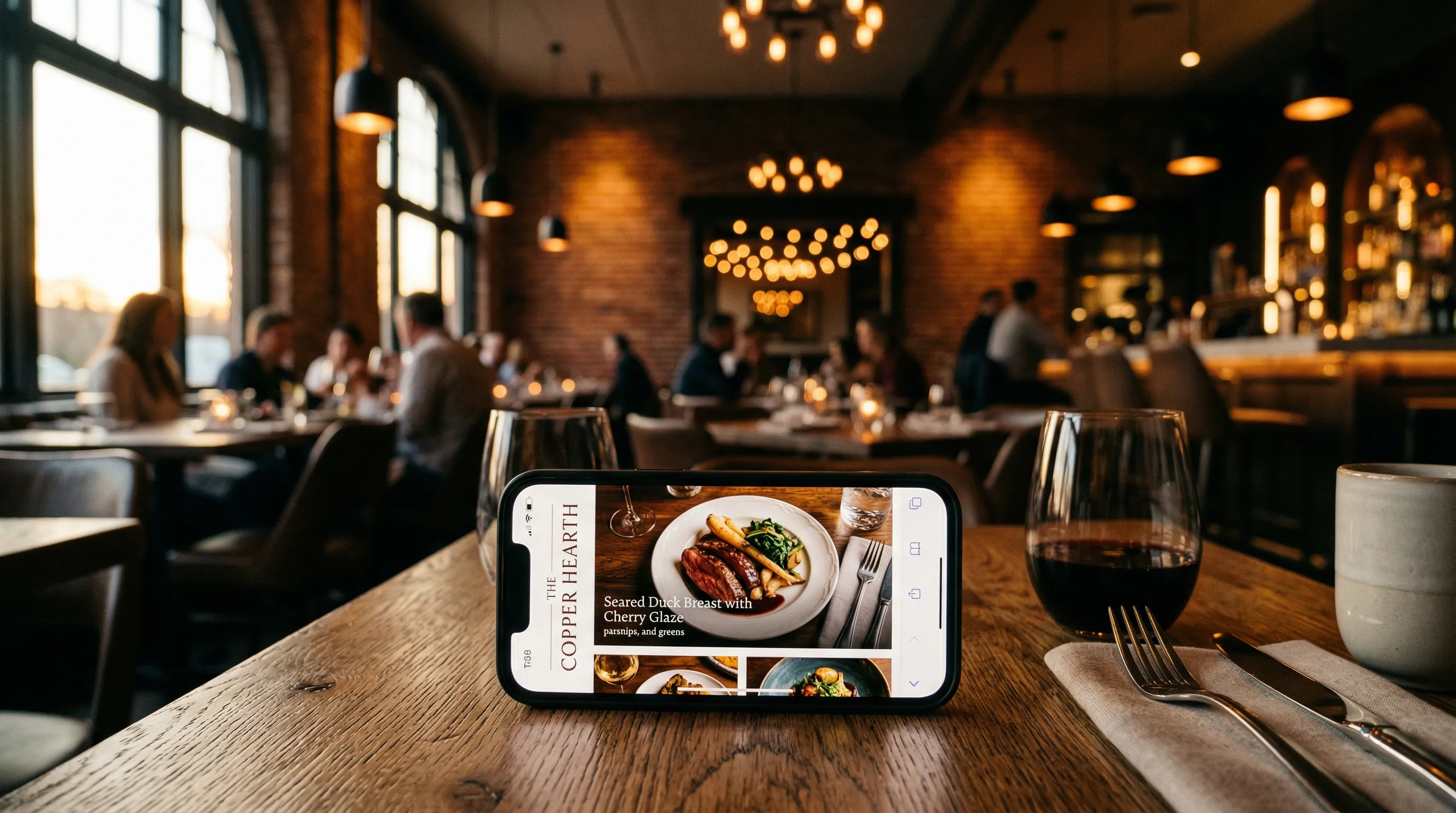
Most restaurant websites are bad. Not "could be better" bad. Actively-driving-away-customers bad. PDF menus that don't load on phones. Stock photos of food that looks nothing like what you serve. A homepage that takes six seconds to load while someone's standing on Del Mar Street in San Clemente trying to decide where to eat in the next ten minutes.
Restaurants have a unique web design problem: the stakes are immediate. Someone searching "restaurants near me" in San Juan Capistrano isn't doing research for next month. They're hungry now. Your website has about three seconds to answer their questions or they're tapping the back button and going to the next result.
What restaurant customers actually need from your site
This is simpler than most restaurant owners think. People visit your website for exactly four reasons:
1. To see the menu 2. To find your hours and location 3. To make a reservation or order online 4. To get a feel for the vibe
That's it. Everything else is noise. Your website's job is to deliver those four things as fast as possible, especially on a phone. Over 75% of restaurant searches happen on mobile devices. If your site doesn't work flawlessly on an iPhone, you're invisible to three-quarters of your potential customers.
The menu problem
Look, we need to talk about PDF menus. They're the single most common mistake on restaurant websites and they need to die. A PDF menu on mobile is a nightmare — pinch to zoom, scroll sideways, lose your place, give up. It's an accessibility disaster for people using screen readers. And Google can't index the content properly, which means your menu items aren't showing up in search results.
Your menu should be HTML text on your website. Actual text that Google can read, that loads instantly, and that reformats cleanly on any screen size. If you change your menu seasonally — and most good restaurants in South OC do — it should be easy to update without needing a designer.
A seafood restaurant in Dana Point updated their site from a PDF menu to a clean HTML menu page last year. Their mobile bounce rate dropped by 38% in the first month. People were actually reading the menu instead of leaving. That's not a design opinion — it's data.
Photography makes or breaks you
Nobody wants to see stock photos of pasta. Your customers can tell in a fraction of a second whether that photo is actually your food in your restaurant or a generic image from a stock library. Every photo on your site should be real — your dishes, your space, your people.
You don't necessarily need a professional photographer, though it helps. Modern phone cameras are good enough if you have decent lighting. Shoot near a window during the day. Don't use flash. Get close to the plate. Take 50 photos and pick the best 10. That's infinitely better than downloading stock images of "Italian food" and hoping nobody notices.
For restaurants in the San Juan Capistrano historic district or along PCH in Dana Point, your physical space is part of the draw. Show it. A cozy patio with string lights, an open kitchen, a bar with character — these create emotional responses that stock photography never will. People eat at restaurants for the experience, not just the food. Your website should communicate that experience before they walk in.
Speed is everything
According to [Google's research on mobile page speed](https://www.thinkwithgoogle.com/marketing-strategies/app-and-mobile/mobile-page-speed-new-industry-benchmarks/), 53% of mobile users abandon a site that takes longer than three seconds to load. For restaurants, this is catastrophic because almost all of your web traffic is mobile and almost all of it has immediate intent.
The biggest speed killers on restaurant websites are unoptimized images, heavy WordPress themes, and third-party widgets. That Instagram feed embed on your homepage? It's adding two seconds to your load time. That parallax video background of your dining room? Another three seconds. Meanwhile, the taqueria down the street with a clean, fast site is stealing your customer.
Run your restaurant website through [Google's PageSpeed Insights](https://pagespeed.web.dev/) right now. If your mobile score is below 70, you have a problem. We've seen restaurant sites in Orange County scoring in the 20s and 30s — essentially unusable on mobile. The owners had no idea because they only ever checked the site on their desktop.
Local SEO for restaurants is a different game
When someone searches "best Thai food in Mission Viejo," Google isn't just looking at your website. It's weighing your Google Business Profile, your reviews, your proximity to the searcher, and your website's relevance and technical health. All of these factors work together.
Your Google Business Profile is arguably more important than your website for restaurant discovery. Keep your hours updated — especially holiday hours, because nothing drives a worse review than someone showing up to a closed restaurant. Upload new photos regularly. Respond to every single review, including the negative ones. Google rewards active profiles.
On your website, make sure your name, address, and phone number match your Google Business Profile exactly. Include your city and neighborhood names naturally in your content. If you're a pizza restaurant in Ladera Ranch, the phrase "pizza in Ladera Ranch" should appear on your homepage — not stuffed in there awkwardly, but as part of a natural sentence.
Schema markup is the technical layer that most restaurant sites miss entirely. Adding LocalBusiness and Restaurant schema tells Google exactly what you are, where you are, what you serve, and when you're open. This data powers the rich results you see in Google — the cards with hours, ratings, and price range. Without schema, you're leaving that visibility on the table.
We go deeper on local SEO fundamentals in our [SEO basics post](/blog/seo-basics-for-small-businesses) — worth a read if you want to understand how Google decides which restaurants to show first.
Online ordering and reservations
If you offer takeout or delivery, the ordering experience on your site matters. A lot of restaurants outsource this entirely to DoorDash, Uber Eats, or Toast. That's fine for discovery, but those platforms take 15–30% of every order. Having your own online ordering — even a simple one — lets you keep that margin.
For reservations, tools like Resy and OpenTable integrate easily with most websites. The key is making the reservation button impossible to miss. It should be in the navigation, on the homepage above the fold, and ideally sticky on mobile so it follows the user as they scroll.
A common mistake we see with restaurants in South OC is burying the reservation or order button three scrolls down the page. Put it at the top. Put it at the bottom. Put it in the middle. People should never have to hunt for the action you most want them to take.
What a good restaurant website looks like
Strip away all the trends and opinions and you're left with something pretty simple. A good restaurant site has:
A fast-loading homepage with one strong photo, your cuisine type, your location, and a clear call to action. An HTML menu that's easy to scan on a phone. Your hours and address with a link to maps. A way to make a reservation or order online. A few photos of your actual food and space. Contact information.
That's a five-section single page or a simple three-page site. It doesn't need to be complicated. A ramen shop in Irvine doesn't need a twelve-page website with an animated origin story. They need a menu, an address, and a button that says "Order Now."
The restaurants in Orange County that do this well — and there are some great examples along the coast and in the inland cities — share a common trait: they keep it simple, they keep it fast, and they let the food do the talking.
Don't forget about Google Maps
A massive percentage of restaurant discovery happens directly in Google Maps, not through traditional search. When someone opens Maps and searches "sushi near me" in Lake Forest, your Google Business Profile is what they see. But when they tap your website link from that Maps result, they land on your actual site.
This is the moment most restaurant websites fumble. Someone was interested enough to tap through from Maps — meaning they're seriously considering visiting — and they hit a slow, confusing website that doesn't answer their questions. Make that transition seamless. Your website should reinforce the decision they've already half-made.
If you're running a restaurant in South Orange County and your website isn't pulling its weight, it's worth fixing. The competition is real — there are hundreds of restaurants between San Clemente and Irvine, and the ones with strong web presence are capturing diners that the others never even see. [Talk to us](/contact) about what a restaurant-focused website build looks like, or check out our post on [web design trends in Orange County](/blog/web-design-trends-orange-county) for more on what's working right now.
Get in touch with WERKSTATT OC — Web design for small businesses in South Orange County.