Web Design for Real Estate Agents in Orange County
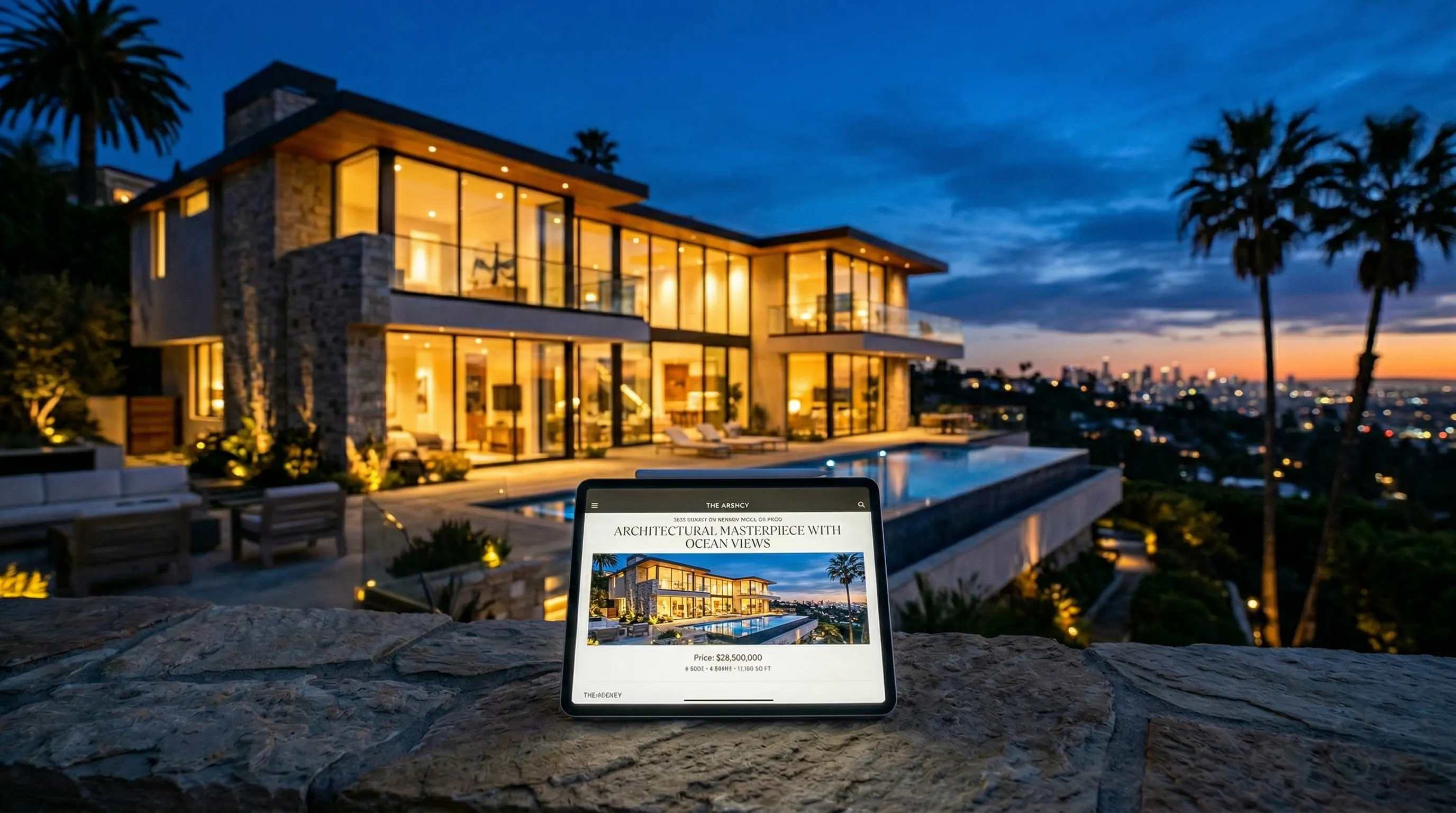
Real estate is one of the most competitive industries in Orange County and somehow most agent websites look exactly the same. The same IDX search widget, the same headshot-in-front-of-a-house hero image, the same "Your Trusted Local Expert" headline. It's a sea of sameness, and it's costing agents deals.
Here's the thing — your website isn't a digital business card. It's not a place to park your headshot and your phone number. In 2026, a real estate agent's website is a lead generation machine, a brand statement, and often the deciding factor when a potential seller is choosing between you and the three other agents they're considering.
Let's talk about what actually works.
Why template sites hurt real estate agents specifically
Every major brokerage — Keller Williams, Compass, Coldwell Banker, RE/MAX — provides agents with template websites. They're functional. They have IDX integration, lead capture forms, and your branding applied over a standard layout. And they look exactly like every other agent at your brokerage.
That last point is the problem. When a homeowner in Newport Beach is interviewing agents to sell their $2.5 million property, they're checking websites. If your site looks identical to three other Compass agents in the area, what's differentiating you? Nothing visual. Nothing experiential. You're competing purely on your pitch during the listing appointment, having already lost the opportunity to make a strong first impression online.
The agents closing the most deals in Orange County — the ones consistently winning listings in Laguna Beach, Irvine, Dana Point, and San Clemente — almost always have a personal website that stands apart from their brokerage template. It's not a coincidence.
What high-performing real estate sites have in common
After working with agents across South Orange County, we've noticed consistent patterns in the sites that actually generate business.
**A clear geographic focus.** The best agent sites own a market. Not "Orange County" broadly — that's too vague. A specific area: "South Orange County Coastal" or "Irvine and Tustin" or "San Clemente and San Juan Capistrano." When a seller sees that your entire web presence is focused on their specific neighborhood, it communicates expertise that a generic county-wide site never will.
**Sold listings, not just active ones.** Anyone can display active MLS listings. What builds credibility is showing what you've actually sold. A gallery of closed transactions — with prices, locations, and timelines — demonstrates track record in a way that credentials and testimonials alone can't match. An agent working the Turtle Rock neighborhood in Irvine should have every Turtle Rock sale prominently displayed.
**Market content that proves local knowledge.** Monthly market updates for your target neighborhoods. A post about the new development approved near Portola Springs and what it means for property values. Analysis of how the Spectrum District's growth is affecting Irvine resale prices. This isn't content marketing for content marketing's sake — it's demonstrable proof that you know the market.
**Speed.** We keep coming back to this because it matters so much. Real estate sites are notoriously slow because they pull large property images, load IDX widgets, and run on WordPress with fifteen plugins. Every second of load time costs you visitors. A potential seller checking your site on their phone during a lunch break at the Irvine Spectrum doesn't have patience for a five-second load time.
The IDX question
IDX — the technology that lets you display MLS listings on your site — is table stakes for real estate websites. But how you implement it matters enormously.
The default IDX widgets from providers like IDX Broker or Showcase IDX are functional but generic. They look the same on every agent site. The search experience is clunky. The property detail pages are template-driven. And they add significant load time to your site.
Better approach: use IDX for the data but customize the presentation. Custom property detail pages that match your site's design. A search experience that's fast, intuitive, and doesn't feel like it was bolted onto a different website. Featured listings displayed as visual stories rather than grid cards.
The goal is for a visitor to feel like they never left your site when browsing listings. If the IDX section looks completely different from the rest of your pages, the experience feels disjointed and the trust you built on your homepage evaporates.
Photography and video
Real estate is a visual business. This is obvious. But the gap between what most agent websites show and what they could show is massive.
Your headshot matters. Professional, current, and high-quality. Not a cropped photo from a friend's wedding. Not a glamour shot from 2015. A current professional headshot that looks like you actually look when someone meets you for a listing appointment.
Property photography on your site should showcase your best work. If you invested in professional photography for a listing in Laguna Niguel — drone shots, twilight exterior, staged interiors — that content should live permanently on your website as a portfolio piece, not disappear when the listing closes.
Video is increasingly important. Neighborhood tour videos perform exceptionally well for SEO and social media. A two-minute video walking through the Woodbridge neighborhood in Irvine, highlighting the lakes, the parks, the schools, and the typical home styles — that's content a seller in Woodbridge will watch, share, and remember when they're choosing an agent.
SEO for real estate agents
Real estate SEO in Orange County is brutally competitive. National portals — Zillow, Redfin, Realtor.com — dominate for most listing-related searches. You're not going to outrank Zillow for "homes for sale in Irvine." Don't even try.
Where you can win is on long-tail, neighborhood-specific, and advice-oriented queries. "Best neighborhoods in Irvine for families." "San Clemente vs Dana Point for home buyers." "What's it like living in Talega." "How to sell a house in Turtle Rock." These are the searches that real buyers and sellers type, and they're the ones where a local agent with quality content can rank.
Each of these search queries is a potential blog post or neighborhood page. Over time, a library of 30–50 hyperlocal content pieces creates a web of topical authority that Google recognizes. You become the definitive online resource for your specific market, which translates directly into organic leads.
Our [SEO basics guide](/blog/seo-basics-for-small-businesses) covers the fundamentals. For real estate specifically, the priorities are: Google Business Profile optimization, hyperlocal content, fast page speed, and backlinks from local sources.
Lead capture that doesn't annoy
Pop-ups that appear two seconds after landing on a real estate site are one of the fastest ways to lose a potential client. So are gated listing searches that require an email before showing results. Both still exist on a shocking number of agent sites in Orange County.
Better approach: provide value first, ask later. Let people search freely. Show full listing details without requiring registration. Offer something genuinely useful in exchange for contact information — a neighborhood guide, a home valuation estimate, a market report. The visitor should feel like they're getting something, not being held hostage.
Place your contact form and phone number prominently but not aggressively. A sticky "Contact Agent" button on mobile works well. A brief form on your homepage — just name, email, and a message field — converts better than a twelve-field questionnaire asking about timeline, budget, property type, and pre-approval status.
What to invest
A custom real estate website typically runs $5,000–$15,000 depending on the complexity of IDX integration, the number of neighborhood pages, and whether you're including custom content and photography. That's a meaningful investment, but consider the math: one additional listing per year from improved web presence more than covers the cost in commission.
We cover the full pricing landscape in our post on [how much a website costs in Orange County](/blog/how-much-does-a-website-cost-in-orange-county). For agents, the ROI is among the highest of any industry because the transaction values are so large. A $5,000 website that generates one extra $1 million listing per year has an ROI that would make any marketing channel jealous.
The bottom line for OC agents
The agents who are winning in Orange County real estate right now aren't the ones with the most experience or the biggest ad budgets. They're the ones who show up best online. A professional, fast, content-rich website that demonstrates hyperlocal expertise is the single highest-leverage marketing asset you can build.
Stop relying on your brokerage template. Stop paying for a website that looks like everyone else's. Build something that reflects how you actually work and what you actually know about your market. Your future clients are Googling you right now — make sure what they find is impressive.
[Talk to us](/contact) about what a custom real estate website looks like, or explore our thoughts on [choosing the right web designer](/blog/how-to-choose-a-web-designer) for your project.
Get in touch with WERKSTATT OC — Web design for small businesses in South Orange County.