How to Secure a Vacant Retail Space in Orange County
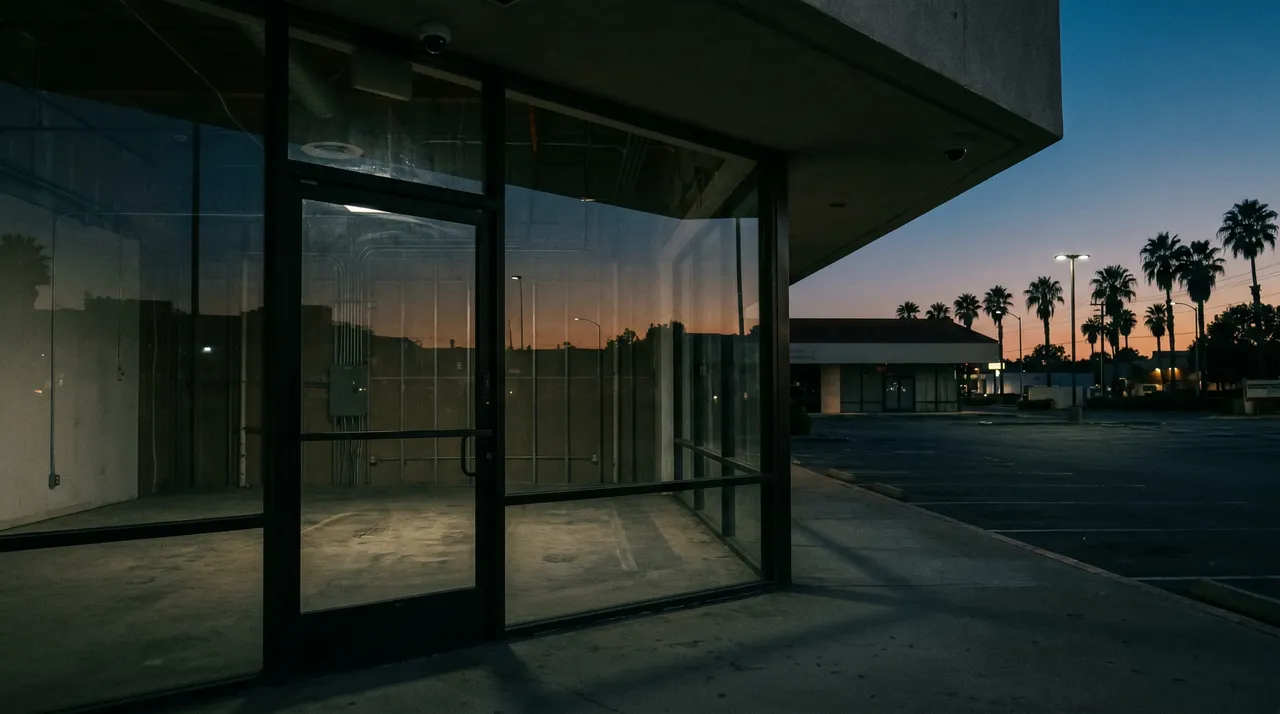
The day a tenant moves out, a vacant retail space changes character. It stops being an operating business with people in it and becomes an empty building that nobody is responsible for hour to hour — and in Orange County that's the real exposure, not a crime wave. Even in low-crime South OC, an empty building is the one situation where the normal protections (staff, foot traffic, a reason for someone to be there) all disappear at once. And because nobody's watching, ordinary problems compound: a door left unlatched, a roof hatch open, a small issue that would be caught in an hour at an occupied site goes unnoticed for two weeks.
Vacant commercial property is exposed for undramatic reasons. There's no one to challenge a person walking in. The building systems themselves have value — copper, HVAC compressors, fixtures, appliances — so an empty building is worth more to the wrong person than an occupied one. And vacancy is visible: papered windows, a dark interior, a "For Lease" sign, an overflowing mailbox all advertise that no one's home. None of this requires a dramatic story; it's just what happens when a space sits unattended.
Why vacant space needs more attention, not less
It's easy to assume an empty building needs less security than an operating one — nothing inside to steal off a sales floor, no cash drawer. The opposite is true. An occupied business is monitored all day by the people who work there. A vacancy has none of that, so anything that goes wrong has time to get worse before anyone notices.
The losses that do happen on vacant property tend to be infrastructure: rooftop HVAC units and the copper in them, panels, fixtures — equipment that's out of sight on a flat commercial roof and easy to overlook from the street. The point isn't fear; it's that the back and top of an empty building are exactly the places no one is looking, which is why coverage there matters more than the front door everyone can see.
The layers that actually protect an empty building
You secure vacant space differently than an operating business, because the goal shifts from "manage daily access" to "detect and respond to anyone present at all." When the building should be empty, every person is an alert.
The setup we recommend for most vacant OC retail:
- **AI-detection cameras** at every entrance, the rooftop access point, and the lot. Because the building's empty, [person detection](/blog/ai-camera-alerts-vs-motion-alerts) is incredibly clean — there's no staff or customer traffic to filter out, so any human triggers an immediate, trustworthy alert.
- **A monitoring plan** so those alerts reach a live person who can verify and dispatch, not just a phone in a leasing agent's pocket. This is the layer that turns detection into response.
- **License-plate recognition** on the lot if vehicle-borne theft — copper, converters, equipment — is the concern. Repeat vehicles casing the property get flagged before the hit. We go deeper on that in our [LPR guide](/blog/license-plate-recognition-commercial-property).
- **Rooftop and perimeter coverage**, which owners almost always forget. The HVAC units and the back of the building are where the real losses happen, not the front door everyone can see.
The principle is simple: an empty building should generate zero legitimate activity, so anything the system sees is worth acting on. That makes vacant-property monitoring some of the most effective security there is — almost no false positives, fast response.
Don't skip the boring, free stuff
Technology layers on top of basic hardening; it doesn't replace it. Before or alongside the cameras:
- Re-key or change the locks the day the tenant leaves. Old tenants, their employees, and their contractors all had keys.
- Secure the roof hatch and any ladder access. This is the copper-theft entry point, and it's usually wide open.
- Keep the exterior lit. A dark building invites; a lit one with visible cameras doesn't.
- Maintain the appearance of activity. Cleared mail, no overgrowth, lights on timers. A building that looks watched gets passed over.
- Lock down the electrical panel and roof equipment access.
None of this costs much, and skipping it undermines everything else. A camera watching a door that anyone can bypass through the roof isn't protecting much.
The leasing-period reality
Here's the tension every owner and property manager knows: you need the space to show well, which means it can't look like a fortress, but you can't leave it exposed during the months it might sit. The resolution is security that's effective without being ugly — discreet cameras, no visible clutter, a system a leasing agent can arm and disarm from a phone, and access control so a broker can let a prospect in without anyone driving out with a key.
A good vacant-property setup actually helps leasing. You can offer touring access without compromising security, you can verify who's been in the building, and a clean modern security system is a selling point to a quality tenant rather than a liability.
Scaling it to the vacancy
A 1,500-square-foot inline space and a 20,000-square-foot former big-box are completely different jobs. The small space might need three cameras and a monitoring plan. The big-box needs perimeter coverage, multiple entrances, roof access points, and a real plan for the loading dock. We quote per site after the free walk, because guessing at this gets you either under-covered or overspent.
For owners and managers with multiple properties, there's also a portability angle: a well-designed vacant-property system can be specified to redeploy when the space leases and the next vacancy opens up, so you're not buying fresh every time.
Get ahead of it
The worst time to think about vacant-property security is after the copper's gone. The best time is the week before the tenant's out, while you can re-key, lock the roof, and have cameras live on day one of the vacancy.
If you've got a space going empty — or one that's already sitting — [book a free site walk](/get-started) and we'll design coverage that protects it and helps it lease. See [the full range of what we install](/services), and that live-response monitoring layer is what separates a vacant building that gets protected from one that just gets recorded.
Get in touch with WERKSTATT OC — Commercial security and low-voltage for businesses across Orange County.