Overhead Music and Paging for Retail and Restaurants
Walk into a lot of OC restaurants and you'll find the same setup running the room's music: somebody's phone plugged into a Bluetooth speaker on a shelf behind the bar. It works until it doesn't. The phone gets a call and the dining room goes silent. A text notification dings over the whole patio. The battery dies at 8pm on a Friday. And the sound itself is loud and harsh near the speaker and gone by the back booths, so the tables up front are shouting and the tables in back are sitting in awkward quiet.
Music is part of how a space feels, and most businesses treat it as an afterthought running on consumer gear that wasn't built to play all day across a room. A real overhead audio system is one of the lower-cost upgrades we install, and it changes the feel of a place more than the price tag suggests.
Why the Bluetooth-speaker approach falls apart
A portable speaker is built to throw sound from one point. Put it in a commercial space and you get a hot spot near the speaker and dead zones everywhere else. Turn it up so the back can hear and the front is unpleasant. There's no setting that fixes a single-source system in a room with depth, because sound falls off fast with distance and one box can't cover an area evenly.
Then there are the interruptions. A phone or a tablet is a phone or a tablet — it rings, it dings, it updates, it dies. None of that belongs in your dining room or on your sales floor, and every one of those interruptions pulls a customer out of the experience you're trying to create.
The fix is the same idea as good lighting. You don't light a restaurant with one bright bulb in the middle. You place many smaller sources so the whole room is covered evenly. Overhead audio does exactly that with sound.
How overhead audio actually works
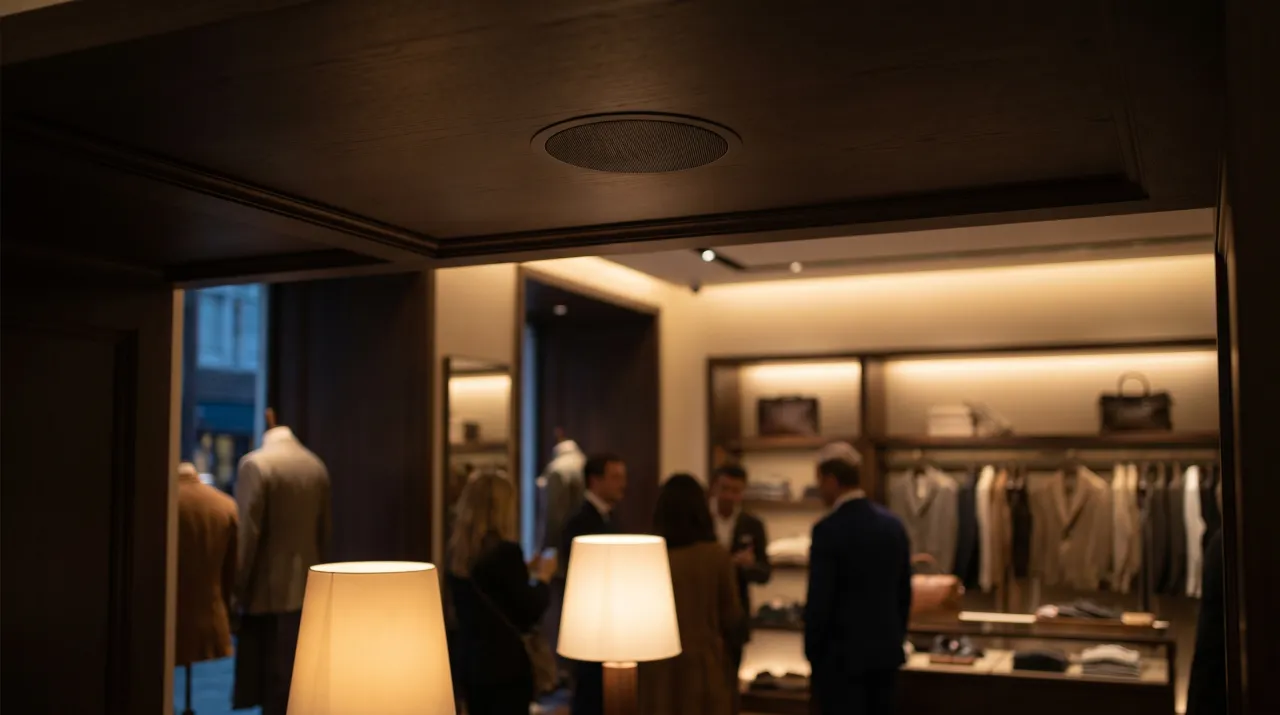
A commercial system spreads a grid of speakers across the ceiling so sound arrives evenly everywhere, at a volume that's comfortable up close and still present at the far wall. Because the speakers are overhead and distributed, you can run it quieter overall and still have it reach every seat, which is what makes a room feel calm and full instead of loud in one spot and empty in another.
The pieces are simple:
- **In-ceiling or surface speakers** placed on a grid sized to the room, so coverage is even and nothing's blasting or missing.
- **An amplifier and source** built to run all day, fed from a streaming music service made for business — properly licensed for commercial play, with curated stations and no ads dropping into your dining room.
- **Volume control** that's set-and-forget or adjustable by zone, so staff aren't fiddling with a phone.
It runs on the same low-voltage cabling we use for [cameras and networking](/services), so if we're already in the ceiling for a security install, adding audio is an efficient add-on rather than a separate project.
Zones are the whole point
A single room can get away with one zone. Most real businesses can't, and zoning is where overhead audio earns its keep. A zone is just an area you control independently, and almost every retail and restaurant space has natural ones:
- **Dining room and patio** as separate zones, so the patio can be a little louder against street noise while the dining room stays conversational.
- **Bar versus main floor**, so the bar carries more energy without making the tables shout.
- **Sales floor versus fitting rooms or back office**, so customers get the music and your staff areas stay quiet.
- **A retail shop's front versus a quieter consultation area**, where you want to actually hear each other.
With zones, one system serves the whole space without forcing every area to the same volume and the same mood. That flexibility is the difference between background sound that works and a compromise that's wrong somewhere no matter where you set it.
Paging, and why restaurants want it
Once you've got overhead speakers in every zone, paging is nearly free to add, and it's genuinely useful. A retail store can call a manager to the floor or announce a closing without anyone shouting across the building. A restaurant can page the kitchen or notify staff. A larger shop can make a clean announcement that reaches every corner instead of a voice that carries to half the room.
A few ways businesses use it:
- **Staff paging** — call someone to the front, the phone, or a specific zone without leaving your spot.
- **All-call announcements** — closing time, a quick notice, an emergency message that reaches everyone at once.
- **Zone paging** — speak to just the stockroom or just the kitchen without interrupting customers out front.
The system ducks the music automatically when someone pages, then brings it back when they're done. It's the kind of small, reliable capability that a phone-and-Bluetooth setup simply can't do.
It plugs into the rest of your system
Because overhead audio runs on the same cabling and gets installed by the same crew as your security work, it's worth thinking about together. When we're already running low-voltage for [cameras and access control](/blog/access-control-small-commercial-buildings), pulling the speaker lines on the same trip saves a separate ceiling job later. We see this on a lot of buildouts around [Costa Mesa](/security-cameras-costa-mesa) and the rest of the county — a new restaurant or shop doing cameras, network, and audio in one coordinated install ends up cleaner and cheaper than stitching three vendors together after the fact.
It's not security, and we won't pretend it is. But it's part of how a commercial space actually functions, and it's the kind of thing we can fold into a project we're already doing well.
What it costs and how we scope it
Price tracks the size of the space and the number of zones, so there's no flat figure. A single-room shop with one zone is a small job. A restaurant with a dining room, a bar, and a patio, each on its own zone with paging, is a bigger one. We quote per site after the free walk, after we've seen the room and understood how you actually use each area.
If your music dies when a phone rings, blasts the front while the back sits in silence, or you just want a room that sounds intentional, [book a free site walk](/get-started) and we'll lay out the zones and what it takes to cover them. You can also see [everything we install](/services) — audio fits naturally alongside the cameras and network most of our clients are already putting in.
Get in touch with WERKSTATT OC — Commercial security and low-voltage for businesses across Orange County.