License-Plate Recognition for Commercial Property, Explained
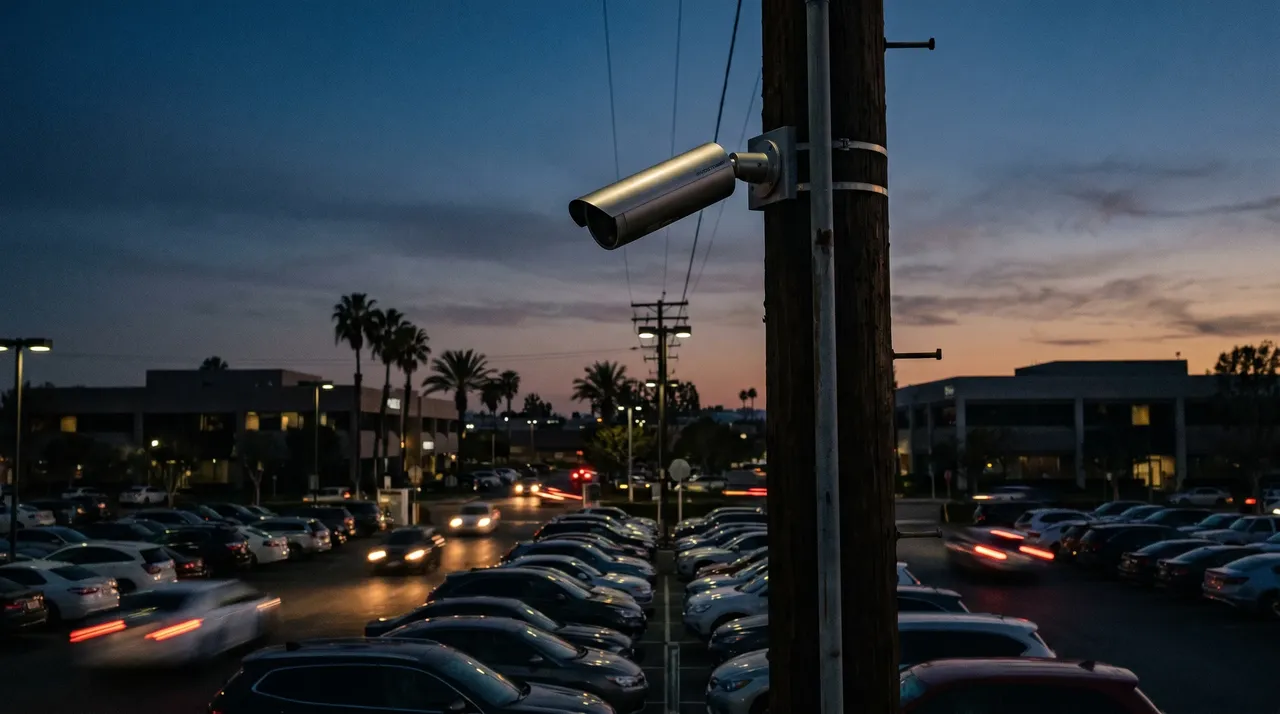
Here's the gap that regular parking-lot cameras leave: they tell you something happened, but rarely give you anything you can act on. An overnight event in the back row of a lot reads as a figure, a vehicle, a quick exit — and then nothing. No face, no plate, no lead. For a property manager, that's footage that satisfies an insurer's paperwork and resolves exactly nothing.
License-plate recognition is the camera built to close that gap. Put LPR on the entry and exit lanes and you capture the vehicle, the plate, and the entry and exit times — and because the system keeps a searchable log, you can see whether that same plate has been on the property before. That's the difference LPR makes. It turns "something happened here" into "here's the vehicle, and here's the pattern." For most OC commercial property the value isn't drama; it's having a real identifier when you need one and a clean record the rest of the time.
What LPR actually does
A license-plate recognition camera is a specialized device tuned to do one thing well: read plates accurately, day and night, on moving vehicles. It's not a regular camera you point at a parking lot and hope. The lens, the shutter speed, the infrared illumination, and the software are all built around capturing a legible plate at speed and in bad light, which is exactly when normal cameras fail.
Every plate that passes gets logged with a timestamp and an image. The system builds a searchable record. You can look up a specific plate, see every time that vehicle was on your property, and get alerted in real time if a flagged plate returns. For commercial property, that's a fundamentally different tool than footage you scrub through after the fact.
Where it earns its keep
LPR isn't right for every site, but where it fits, it's one of the highest-value cameras you can install:
- **Parking structures and lots** with recurring vehicle break-ins, converter theft, or vandalism.
- **Strip centers and shopping centers** where the same offenders rotate between tenants.
- **Industrial and flex space** with valuable equipment, trailers, or after-hours access concerns.
- **Self-storage and yards** where you want a record of every vehicle in and out.
- **Multi-tenant office** where parking abuse or unauthorized access is a problem.
The common thread is vehicles. If your risk arrives and leaves on wheels, LPR captures the one identifier hardest to disguise. People wear hoods and masks. Plates sit right out in the open, and they tie to a registered owner.
Placement is the whole game
This is where DIY and cheap installs fall down. An LPR camera has a narrow effective zone — a specific distance, angle, and height where it reads plates reliably. Mount it too high, aim it too wide, or put it where headlights wash out the image at night, and you get a beautiful camera that captures unreadable plates.
The right setup usually means dedicating a camera to each entry and exit lane, positioned to catch plates straight-on as vehicles slow at the entrance. We pair it with a separate overview camera so you get the plate and the context — the plate read from the LPR cam, the scene and the person from the overview. One without the other leaves a gap.
We sort this out during the site walk by looking at your actual traffic flow: where cars enter, where they slow, where the light is at night, where a plate is genuinely visible versus where you just wish it were.
Honest limits you should know
LPR is powerful, not magic. A few things to be clear-eyed about:
- It reads plates, not intent. It tells you a vehicle was present; it doesn't prove that vehicle's occupant did anything.
- Paper plates, missing plates, and obscured plates exist. Organized crews sometimes run without front plates or with stolen ones. LPR still logs the rest and still narrows the field.
- It's an investigative and deterrent tool, not a complete answer. It works best layered with [AI-detection cameras](/blog/ai-camera-alerts-vs-motion-alerts) and good overview coverage.
- The data is yours and it accumulates. That's the value, and it's also a reason to think about retention and who can search the log — we set that up deliberately.
Anyone selling you LPR as a complete security solution by itself is overselling. It's one strong layer.
LPR plus everything else
The reason LPR works so well for OC commercial property is that it fills the exact hole other cameras leave. Standard cameras tell you what happened on the property. AI detection tells you when, and flags it fast. LPR tells you who arrived and whether they've been here before. Put together, you go from reactive footage review to a system that builds patterns and surfaces leads.
For a retail tenant worried about [organized theft](/blog/what-actually-stops-retail-theft), LPR on the shared lot is often the single most useful thing a center can add, because the same vehicles show up across stores. For a property manager, it's a tool that pays for itself the first time it resolves an incident the insurer or police would otherwise have written off.
What it costs and how we quote it
There's no flat price, because the right number of LPR cameras depends entirely on your entry points and lanes. A single-entrance lot might need one or two. A center with three driveways and a back alley needs more. We quote per site after the free walk, so you're paying for coverage that actually reads plates, not a guess.
If you've got a parking lot, structure, or yard where vehicles are part of your risk, [book a free site walk](/get-started) and we'll map where LPR actually pays off. You can also see [the full range of what we install](/services), or for a coastal property, our [Newport Beach security camera work](/security-cameras-newport-beach) covers the same approach for the harbor and Fashion Island area.
Get in touch with WERKSTATT OC — Commercial security and low-voltage for businesses across Orange County.