Commercial Security and Technology in Irvine, OC
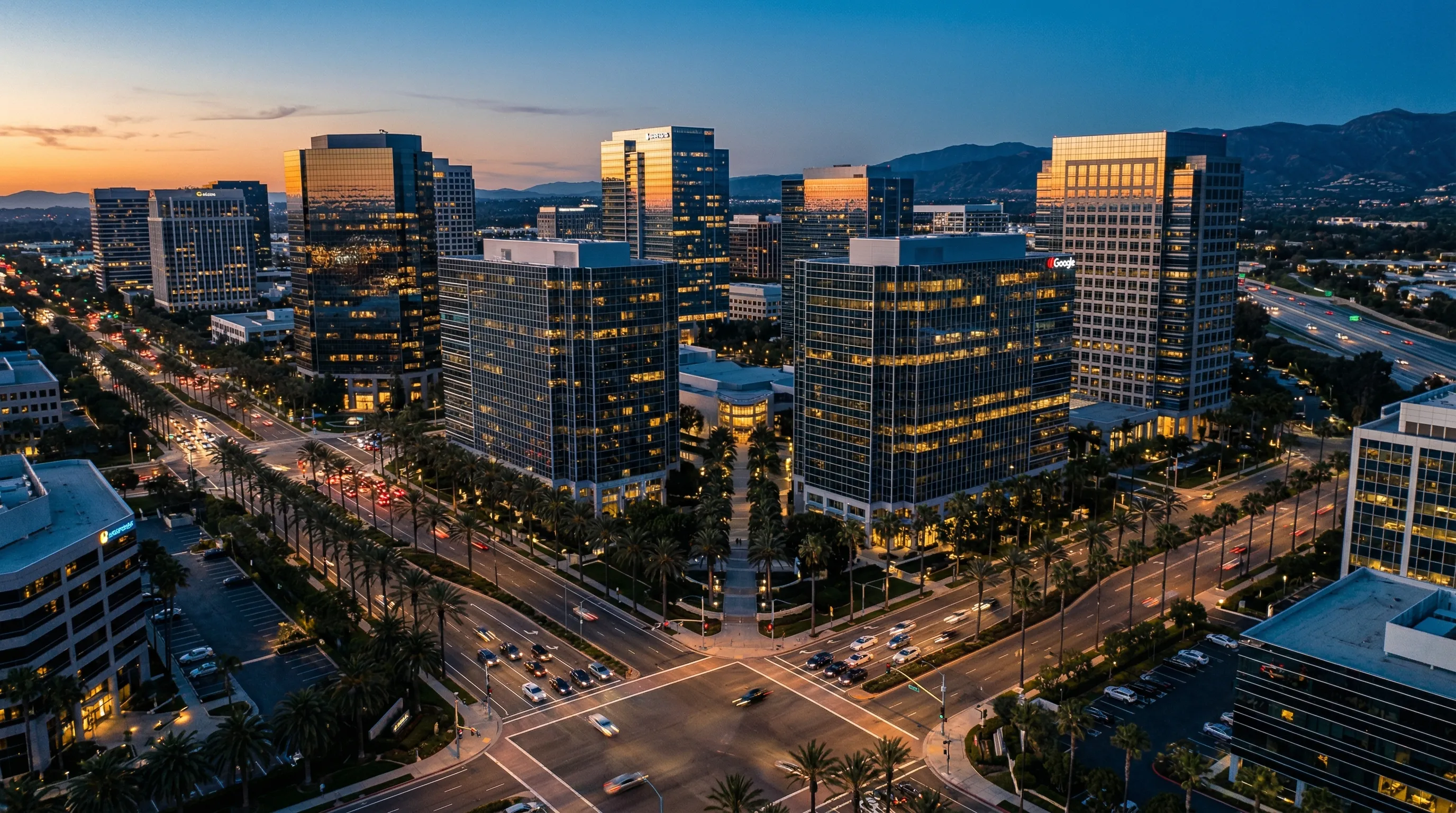
Irvine is a different kind of commercial environment than the rest of Orange County. Most OC cities have business real estate scattered across a typical suburban mix — a strip center here, a medical office there, some flex space near the freeway. Irvine built its commercial infrastructure at a different scale: planned corporate campuses, dense office parks around the Irvine Business Complex, a sprawling retail and entertainment hub at the Spectrum, medical and research buildings near UCI, and airport-corridor business parks full of tech and life sciences tenants. The result is a city where property managers routinely oversee eight or ten buildings, where a single complex might host dozens of tenants, and where the baseline expectation for what "adequate infrastructure" means runs higher than almost anywhere else in the county.
That scale shapes how technology problems show up here — and why the fragmented-vendor approach that's frustrating elsewhere becomes genuinely unmanageable at Irvine's commercial density.
The multi-building management problem
The typical Irvine portfolio manager we work with is overseeing a mix of office buildings spread across two or three business parks. Each building got its technology piecemeal, installed by whoever was available at the time: a few cameras from one vendor, a router from whatever ISP the last major tenant chose, a DVR in a utility closet that hasn't been serviced in two years. None of it talks to anything else.
For seven or eight buildings, that fragmentation costs real time. Seven separate camera systems to check. Seven separate networks to troubleshoot. Different vendors for each property, no unified view of how the portfolio is performing, and no single support relationship. When something needs attention, it requires a site visit to determine which piece from which install has failed.
The alternative is designing the whole portfolio to the same standard from the start: cameras, access control, and networking that are consistent across buildings, visible from one interface, with one vendor and one call when something needs attention. The operational difference compounds across a portfolio — and it's the approach we take for Irvine commercial property from small multi-tenant offices to larger campus environments. We cover the broader framework in our [commercial property management guide](/blog/commercial-property-management-security).
Access control across tenant turnover
Multi-tenant office in Irvine has real credential churn. Companies add and lose staff. Suites change hands. Shared amenities — lobbies, parking structures, elevator banks, conference rooms — need access control that tracks with who's actually in the building, updated as the tenant roster changes.
Physical keys fail at this scale in the predictable ways. Re-keying a four-building complex when a significant tenant turns over costs money and leaves a gap during the transition. Keys get copied. Contractor keys don't come back. Shared-entrance keys end up with people nobody intended to give access to. None of this is a security catastrophe in a city as safe as Irvine; it's an administrative tax that accumulates and eventually creates an event.
What a credential-managed system changes in practice:
- Each tenant manages their own suite while building management controls common areas and structure access independently
- When a company vacates, their credentials are deactivated before the keys are returned, not after
- Mobile credentials for contractors and vendors eliminate the drive-out for routine facilities visits
- Time-based schedules mean the HVAC tech has a specific access window, and that's it
For a Spectrum-area retail complex, the same logic applies differently — tenant employee access, delivery credentialing, and vendor scheduling all benefit from the same revoke-and-reissue capability without involving a locksmith.
Network infrastructure that matches tenant expectations
Tech and life sciences tenants in Irvine have a higher floor for what "adequate" looks like in building infrastructure. A software company or a biotech firm notices when the WiFi drops or the VPN is unreliable, and when it does, it lands on the property manager.
A single access point in the ceiling and an ISP router in the utility room isn't infrastructure — it's a starting point that fails under real load. A properly built commercial network in an Irvine office building means:
- Commercial ceiling-mounted access points on every floor, wired to managed switches rather than daisy-chained on WiFi
- Separate network lanes: tenant staff, guest WiFi, building systems (cameras, access control), and shared services each on their own segment
- A managed layer that can be monitored and restarted remotely without a site visit for routine issues
- Configuration that's documented and consistent across every building in the portfolio
In an Irvine corporate environment, the stakes for getting this wrong are higher because the tenants have options and they notice the difference between a real commercial network and a consumer router behind a glass door.
Camera coverage at campus scale
Irvine's office parks and corporate campuses have camera challenges that differ from a South OC strip center. Parking structures are the common one: multi-level decks with hard-to-illuminate dead zones and a higher rate of vehicle incidents than surface lots. Landscaped buffer zones between buildings create coverage gaps. Service alleys and loading docks get after-hours activity from facilities vendors and delivery drivers that nobody's watching.
Camera positions that matter most in an Irvine office complex:
- Lobby entry and elevator banks — establishing who entered the building and when
- Parking structure entry and exit lanes, where license-plate capture adds an identifier that footage alone doesn't provide
- Service and loading dock areas, which see the most vendor traffic and the least management attention
- Exterior paths between buildings, especially in multi-structure campuses where the gaps are where problems tend to go undetected
AI person-detection is what makes after-hours alerts worth having in this environment. A motion-alert system on a landscaped campus generates enough noise from trees, headlights, and wildlife that most managers turn the alerts off within a week. AI detection flags a person in a location where no one should be, and nothing else — which is what makes the alerts worth reading.
Monitoring when nobody's in the building
Office buildings in Irvine are well-staffed during business hours and empty otherwise. That's not a high-crime situation — Irvine is consistently one of the safest cities in the country. But the after-hours window is a long stretch when a system failure, a propped door, or a vehicle incident in the parking structure goes unnoticed until morning.
A monitoring plan covers that gap. At its core it's system health checks so a camera that drops offline gets flagged to us before it becomes a gap in coverage the night something happens, cloud storage so footage isn't dependent on a recorder inside the building, and alerts that reach someone who can act rather than waiting for the morning check. Monitoring plans start at $149/mo on a month-to-month basis — what's included and how the tiers work is covered in detail on our [services page](/services).
For a property manager overseeing multiple Irvine buildings, monitoring changes the operational dynamic considerably. Instead of requiring drive-bys to verify that everything is functioning, the buildings report their own status. A portfolio that surfaces after-hours events automatically is a fundamentally different workload than one that requires constant manual verification.
The practical case for a single vendor
Fragmented technology across a portfolio has a cost that doesn't show up on any single invoice. It shows up as the hour troubleshooting a camera that doesn't like the network from a different vendor. It shows up as the service call that falls in the gap between two vendors' scope. It shows up as the Monday morning when footage from a specific building is unavailable because a recorder from an old install went offline and nobody knew.
We install cameras, access control, networks, overhead audio, and monitoring — designed to work together from the start. When a door event needs video verification, the camera and the door log are already connected. When a new tenant moves in, credentials and camera schedules update together. When something needs attention, one call covers it.
For Irvine property managers dealing with multi-building installations and the coordination overhead they generate, that coherent vendor relationship is where the real operational value shows up.
Getting started
We serve Irvine and all of Orange County from our South OC base, with the same approach from [Newport Beach](/security-cameras-newport-beach) through the airport corridor and across the county. The free site walk covers your actual buildings: existing systems, coverage gaps, and what a coherent buildout looks like for your specific portfolio.
[Book a free site walk](/get-started) and we'll map the system your properties actually need. Or browse [everything we install across all six services](/services) — cameras, access control, network, audio, monitoring, and websites — and how the pieces fit together.
Get in touch with WERKSTATT OC — Commercial security and low-voltage for businesses across Orange County.