How We Built Night Night — An AI Bedtime Story Platform
Every project we take on is a version of the same problem: how do you make someone trust a product they\'ve never used, in the few seconds they give you before clicking away? Night Night made that problem interesting.
Night Night is an AI platform that generates personalized, illustrated 3-page storybooks for children — narrated in a warm, gentle voice. You tell it what happened in your child\'s day. It turns that into a bedtime story with your kid as the main character, illustrated in a style that looks like it came from a children\'s publisher. The product is genuinely magical. The challenge was convincing a parent of that in about four seconds.
The audience changes everything
Parents are not a forgiving audience for anything involving their kids and technology. The words "AI" and "children" in the same sentence trigger a reasonable amount of skepticism — algorithmic content, screen time concerns, privacy questions. The site couldn\'t lean into the tech angle at all. It had to lead with something that felt warm, safe, and human.
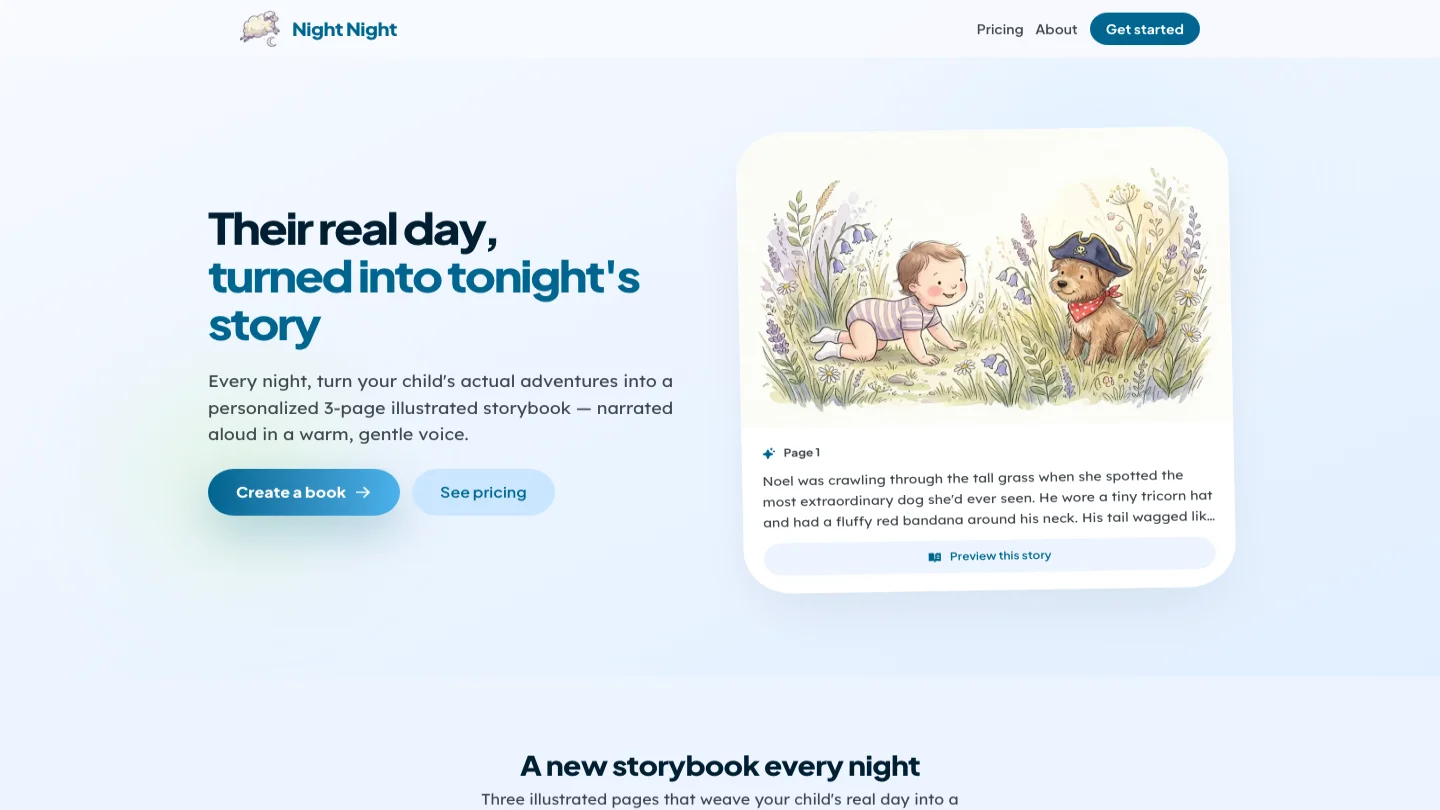
We spent a lot of time on the headline before landing on "Their real day, turned into tonight\'s story." That sentence does a lot of work. It\'s specific (their real day, not a generic fairy tale), it\'s relational (their story, not the app\'s story), and it implies a ritual — tonight, not just once. It tells a parent exactly what this is without using the word "AI" at all.
Show the product, don\'t describe it
The biggest trust-builder for Night Night wasn\'t copy — it was the product preview in the hero. We placed a live illustrated page from an actual generated story directly next to the headline: a baby crawling through tall grass, spotting a dog in a tiny tricorn hat and a fluffy red bandana. It reads immediately. You understand what the output looks like before you\'ve read a single line of description.
This matters more for AI products than almost any other category because the skepticism is specifically about quality. "Will it actually be good?" is the question parents are asking. Answering that question visually, above the fold, before they\'ve had a chance to bounce — that\'s the whole job of the hero.
Making AI feel simple
The three-step flow — tell us what happened, get a book, read it together — does more than explain the product. It reframes the experience. You\'re not "prompting an AI." You\'re telling someone a story about your kid\'s day, and getting a book back. That framing is intentional and it shows up throughout the site.
Pricing also gets this treatment. Rather than positioning it as a software subscription, we leaned into the nightly ritual angle. A story every night isn\'t a feature — it\'s a habit, a thing you do together before bed. Pricing that reflects that framing converts better than pricing that emphasizes storage limits or generation credits.
What this project reminded us
Night Night is a consumer product targeting parents, not a B2B SaaS or a local service business. The design decisions that work for an Orange County contractor — license numbers upfront, phone number in the header, before-and-after photos — don\'t apply here at all. The trust signals are completely different: warmth, illustration quality, the sense that someone thoughtful made this for families.
Every project we take on reinforces the same thing: the product determines the site, not the other way around. The job is to figure out what your specific audience needs to feel safe enough to try something, and then build everything around that.
If you\'re building something and need a site that actually sells it, [we\'d love to hear about it](/contact).
Get in touch with WERKSTATT OC — Web design for small businesses in South Orange County.